News from our guides in the field

19 October, 2011

Zambezi Trek and Paddle - Sept 2011

By Brad Horn: I wanted to take this opportunity to share with you some footage of a "trek and paddle" safari I guided last month. This trip involved a couple of nights acclimatising in Hwange National Park in Zimbabwe before flying into Mana Pools National Park in the Zambezi Valley. We proceeded to walk across Mana over three and a bit days covering a total of around eighty kilometres. We then had a two night "spell" and the beautiful Ruckomechi Camp before paddling back down the river over two days to the start point. There are few safaris that come close to this for adrenalin and action. The old saying, "from a vehicle you see Africa but on foot you feel Africa" never holds truer than in this case. Mindblowing!

To view some highlights of this amazing trip please click on the below video footage.

For more information, please do not hesitate to contact us.

12 July, 2011

Tanzania and Rwanda - Family Safari - June 2011

By Brad Horn:  I recently had the pleasure of guiding a great family out of Washington DC on a safari to Tanzania and Rwanda.  This was the family's third African safari with Epic, having been previously to Botswana, South Africa and Namibia.  The focus of this trip was the migration in the Serengeti and the mountain gorilla's of Rwanda.

Ordinarily in the latter part of June the migration is principally in the western and lower sections of the northern corridor of the Serengeti. We hedged our bets by choosing two camps; one in the west and the other a little further north. This way we covered all bases. If the migration was more advanced than normal or lagging somewhat we would still be within striking distance. It was just as well we did as this year the migration moved north very early with only rear guard elements still in the western corridor. We did however hit "paydirt" at the more northern location, the Grumeti Reserves.

The Serengeti is such a vast expanse of wilderness and it never ceases to deliver on the game experience. To see the migration in all its glory is certainly one of the wonders of the nature and something that everyone should see at least once in their life. It is hard to comprehend the sheer mass of animals. It is even harder to capture the scale effectively on film. In addition to the million or so bleating wildebeest, all the usual suspects were in attendance; lion, cheetah, hyena, elephants, buffalo and a host of other plains-game species. One of the highlights of the trip was a balloon ride over the Serengeti's vast plains. Words can't describe how special it is silently floating above the animals.

From the Serengeti we flew onto Rwanda and embarked on two days trekking for the highly endangered mountain gorillas. With only 700 or so of these animals left on earth, they are a very rare commodity. In my experience Rwanda delivers the best gorilla experience and it certainly didn't fail to measure up. Our two days couldn't have been more different; the first was a challenging day from both a terrain and weather perspective. The gorilla family we were visiting were lodged deep in a re-entrant. Luckily we were all in good physical shape to make the most of the day. My clients were real troopers and revelled in the challenge. We were rewarded with good viewing including seeing two mothers with very young twins. It is very rare for gorilla's to give birth to twins. The second day was much easier; the weather was fine and we chanced upon the gorillas in a clearing in the forest. We spent a magical hour with a family of 13 gorillas, including the biggest silverback in the Virunga Mountains named Gahonda (weighing an impressive 220 kgs – 480Ibs) all around us. What a way to finish the safari!

To view some highlights from their amazing trip please click on the below video footage.

For more information, please do not hesitate to contact us.

25 May, 2011

Botswana - Trans Okavango - New Video & Report

By Brad Horn: I recently returned from an incredible safari in Botswana.  This realised a long held dream to conduct a transect of the famed Okavango Delta by boat from north to south.  In all my years of living in Botswana and guiding safaris there I never took the time to partake in a trans-Okavango.  Well, good things come to those that wait.  It exceeded all expectations and more!

The trip started in the Kalahari Desert where we spent a couple of days in a wonderful little camp called Kalahari Plains. The Kalahari has just enjoyed a fantastic wet season so the landscape was alive. I have never seen Oryx (gemsbok) in such numbers. One of the highlights was sleeping under the stars on a moonless night. The umbrella of stars is so clear in the pristine unpolluted environment of the Kalahari it is almost suffocating.

From the Kalahari we flew north into the Okavango. Talk about going from the "sublime to the ridiculous". Northern Botswana has enjoyed a double average wet season. Add to this the fact that the highlands of Angola (which supplies the majority of the water to the Okavango) have had similar rains. The Okavango is experiencing the biggest flood in a generation plus. Talk about a "sea of land and a land of water"! Prior to our boating sojourn we spent a deal of time in helicopters over-flying the delta.  It is only from the air that one really gets an appreciation of the extent of floodwaters. Many a safari operator is scrambling to bund airstrips and camps. We also took time to visit the fabled Tsodilo Hills on the north-western extremity of the delta to see the famous bushman rock art. This was a very special side trip.

From the heli's it was into the boats. We didn't see another soul on the water for the next three days (until we got south towards the buffalo fence). Where else in the world can you experience such solitude these days? The game-viewing and scenery were spectacular.

To get a feel for what's in store, check out the below video.  I hope it does the trip justice.

For more information, please do not hesitate to contact us.


18 March, 2011

Epic Kilimanjaro Climb - February 2011

By Brad Horn: Epic Private Journeys led another successful climb up Kilimanjaro via the scenic Machame route.  Led by Kevin Jackson the team of six experienced a variety of weather throughout the climb including periods of rain, snow, wind and sun as they progressed through the various ecosystems. The team consisted of 5 Australians from the beautiful town of Townsville on the northeast coast of Queensland.

The group was assisted by 44 local porters and guides who created an amazing experience on the mountain for the team. As we climbed through the various camps we were welcomed with an unusually low snow level that made for fantastic views. Each camp offered a different vantage point of all three volcanoes as we slowly made our approach to Barafu Camp.


Once we made it to Barafu Camp, our final camp before the summit, we were provided with unobstructed views of the summit and Mt. Mwenzi.  Our team prepared for the summit with a hearty meal and an early night.

We set off for the summit at 11.50 pm with a team rally as we embarked on our long tourney into the dark. As we progressed through the night our team pushed through the urge to make stops and slowly plodded along until we all made it to Stella Point just before 5.30 am.

We spent 20 minutes sharing hot tea before continuing onto the summit. Only as short 45 minutes away, the views of the glaciers and deep into the crater are enough to keep everyone moving slowly as the sun begins to break through the clouds. As we reached 5,895 meters, and Uhuru peak, the tallest point in Africa, we were rewarded with a sunrise that rivaled any other. Our entire team made the summit and after a few images and video clips we made our way back down to the mountain to Mweka Camp for a final night on the mountain.

This was a spectacular climb with a great family, crew and team. Epic is proud of everyone and is excited to be able to share stories with those involved.

For more information, please do not hesitate to contact us.


11 March, 2011

Community project - Gibaso Village, Tanzania

By Rob Barbour: Bill and Vonnie Wavish came on an Epic Safari which I guided to the Ngorongoro Crater, the northern Serengeti and the Maasai Mara in August of 2010. They came with a group of friends to celebrate Vonnie's 50th Birthday.  Whilst at Serengeti Mara Camp in the Lamai Wedge (in the far north Serengeti) Raymond Teekishe - Conservation and Community Development Manager for AfrikaAfrika - and I gave a presentation on the efforts that AfrikaAfrika and Epic were doing in terms of conservation and community development.  As a result of this discussion Vonnie and Bill made an on the spot commitment to fund the building of a teacher's house in Gibaso Village.  This project was high on the development agenda of the Gibaso Village Government.  The house will be in honour of Vonnie's mother and so will be known as the Colleen Bayliss School Teacher's House.

A building plan was acquired with the help of Tanzanian National Parks and the project commenced in January 2011, ably managed by Raymond Teekishe himself.  Ray has been very conscious to ensure all the contracts are allocated to local village members whilst building.

We expect the project to be completed some time in late March or early April.

For more information, please do not hesitate to contact us.


24 November, 2010

Gorillas, Iconic Tanzania and Chole Island (near Zanzibar)

By Heather Moreau (Director, Operations):  I have recently returned from an extended trip through Rwanda and Tanzania visiting a number of Epic’s key preferred properties.  I was fortunate enough to start with trekking to observe the mountain gorillas in Rwanda. This was one of the most rewarding and thrilling adventures I have ever experienced!  Despite having visited Africa many times before, this one hour with a band of gorillas, of which Agasha – a 200 kg male – is the head, was one of the most memorable of my life.

Gorilla 2 Gorilla 1
I then travelled to the Ngorongoro Crater, an absolute icon, where I indulged in the opulence of Crater Lodge. From there I travelled to the Grumeti Reserves (the Singita properties are stunning) and the northern Serengeti. The sheer vastness and stunning beauty of these open and expansive plains dotted with granite kopjes never cease to amaze me.  The migration hadn’t quite made its way south and I was just in time to witness a crossing of the Mara River.  I stayed in a traditional tented camp and loved the feeling of being connected to the bush once again – canvas, bucket showers and all the unmistakable sounds of Africa.

Lamai crossing
It was then down to the remote and contrasting Ruaha National Park, now Tanzania’s largest Park, and the land of the giant baobabs.  Although much drier than the north at this time, the landscape was nonetheless as picturesque and the game viewing as good.  Kigelia Camp is also a tented camp and was superb - spacious tents, great food and the staff were lovely.  I then hopped over to the Selous and to Sand Rivers, which is located on a bend in the Rufiji River with open cottages raised to take in the view and allow the hippos room to move at night.

Elephants Ruaha Ruaha baobab
I left the dust of safari for the coast and flew to Zanzibar where I enjoyed a walking tour of Stone Town and Matemwe in the north-east for some beach time, a perfect add-on to any safari and for those wanting to take in the culture and history of the island.

Chole Island and Chole Mjini Lodge was my next stop –  an untouched, pristine marine haven for diving, snorkelling and swimming with whale sharks.  The local village is supported by the lodge and the village visit was a highlight of my stay. I stopped in at the primary school and saw projects being undertaken here such as boat building, still all done by hand.  I finished with a luxurious night at The Oyster Bay, a beautiful boutique hotel in Dar es Salaam – before heading home.
Rwanda and Tanzania are two countries that should be put into everyone’s “top 10”.

To find out more, please contact us at epic@epicprivatejourneys.com 

Chole boat building Chole school children


02 November, 2010

Wilderness adventure in Australia's remote Kimberley region

Trekking, paddling and abseiling their way through the remote north-western Kimberley region of Australia, Brad Horn and his small group of like-minded adventurers have just returned from a spectacular trip. Challenging, yet intensely satisfying, they lapped up the wilderness and camped in swags each night. Of course an Epic expedition wouldn't be right without a little luxury thrown in - they finished up with an extended low level helicopter flight through the dramatic landscape.

Check out the video to get the full picture.


This adventure was designed for a group of friends all wishing to push themselves and test their mettle in a challenging environment. Please note that we can fully tailor to suit a variety of fitness levels.

11 October, 2010

Wildebeest Rescue in the Northern Serengeti

For years, poaching has been a way of life (and a means of income) for some Tanzanians in the northern Serengeti region. It is due to the constant monitoring of the area and diligence from the likes of Epic's own Rob Barbour and his associates, that the wilderness is now being seen as worthy of protection. 

By Rob Barbour:  Ray Teekishe (our Community and Conservation Manager) and I were doing a liaison visit to the Kenyanganga and Lamai Ranger Posts in the northern Serengeti in September.  Sadly we came across quite a number of wire snares.  As we continued to find them and pull them up we found a young wildebeest alive and still caught in one of the vicious contraptions. 

Despite its very sharp horns I managed to get a small acacia between me and its horns which allowed me to release it safely.  Amazingly, its only wound was a small laceration on its lower right back leg.  It was able to walk but did not appear thankful for its rescue. Ray courageously took the pictures from on top of the bonnet of the Landrover while shouting encouragement (mainly to the wildebeest). 

We are picking up a lot of wire snares and cooperating with TANAPA (Tanzania National Parks). Our presence in the area and our collaboration with the local community will hopefully offer them choices other than poaching and at least discourage them to be in the Park. 

For more details on the conservation efforts taking place within the Lamai Wedge region, and other areas of East Africa, please do not hesitate to contact us.


15 September, 2010

New Botswana & Zambia Video

By Brad: Here is a short video taken in Botswana and Zambia, while guiding clients there recently.

It was an incredible safari with some amazing game interaction.

You will see that we enjoyed many close up encounters including witnessing a cheetah kill, a couple of wonderful sightings of the highly endangered wild dog, leopard on a kill, and numerous fantastic experiences with elephants.


01 September, 2010

23 August, 2010

Epic Photo School 2010, with Greg du Toit


The plans for a photographic expedition had been in the pipeline for quite sometime, and last week saw the launch of the Epic Photo School. This is a brand new safari product and caters specifically for wildlife and nature photographers. The Epic Photo School functions much like a normal safari but with a few important distinctions:

The first being that you are hosted by internationally acclaimed wildlife photographer Greg du Toit (http://www.gregdutoit.com/), who guides and coaches you every step of the way. While on safari, photographers draw on Greg’s extensive bush knowledge and photographic skills, as he highlights unique photographic opportunities and shares camera settings and techniques. The second important distinction making Epic Photo School unique, are the specially designed lessons presented each day. These lessons have been created by Greg and, drawing from his years of wildlife photographic experience, are especially aimed at nature photographers. The course content is structured to contain all the necessary information required to become an expert photographer and cater for all levels of photographers from complete novices through to semi-professionals. As part of the lesson time, each photographer receives valuable feedback on their own work, allowing each to grow and develop in their own personal style of photography. Lastly, the Epic Photo School is unique in that it aims to take photographers to the best wilderness and photographic locations on the African continent.

With the completion of the inaugural Photo School just last week, this comes in hot off the press from Greg:

The Photo School kicked off in the far Northern Serengeti where we all met for the first time on the Kogatende airstrip, after flying in from various corners of the globe. The group was diverse and consisted of a couple from Sydney, Australia (he an avid photographer, while his wife was simply along to enjoy a sublime wildlife safari), a gentleman from Washington D.C., and a CSN sports photographer with an accomplished portfolio of sports images (including impressive subjects such as Tiger Woods and Rafael Nadal - need I say more). We had a guy in from the UK and with his 500mm F4 at the ready, I knew he meant business from the start. And lastly, a Kenyan born lady, now living in the English countryside, although a little nervous at first on the technical aspects of photography, soon proved to have a very artistic eye.


With the group assembled, we met our guide Alex who gave a full brief on how the migration works and where we would soon find the gnus! The base camp for Photo School lay in the far-flung reaches of the northern Serengeti in an area called the Lamai Wedge. Our comfortable mobile camp was positioned right slap bang in the middle of the annual wildebeest migration. So much so, that each night, we were lulled asleep by the moans and groans of millions of wildebeest. A strangely soothing sound I might add! What made this location so unique was the utter lack of other vehicles in the area. Every sighting we had all to ourselves with no one else around, which allowed us to photograph each scene uninhibited as we worked every conceivable angle. The migration has become a popular feature on the international wildlife calendar, and as a result it draws large crowds each year. We however, due to the camp’s excellent location, had the entire migration all to ourselves!


Our days in the Lamai Wedge began with an early 05h30 start. This meant that we were out in the field when it was still dark and most days had found a subject before the sun was up. This allowed us to photograph in the warm and golden morning light! We spent the rest of the mornings out in the field and would stop for a bush breakfast, before returning to camp at midday for lunch. After a short siesta, we met in the dining tent for Photo School. I had carefully planned a series of fun and practically relevant lessons which included the following topics: RAW vs JPEG, exposure compensation, metering, histograms, dynamic range, focus, composition, modes, aperture, shutter speed, ISO, fill flash and light. The course material is specifically designed to first provide a solid foundation upon which each photographer can build. As the Photo School progressed, the lessons moved through to intermediate levels and finally we finished with advanced topics such as fill flash. For each lesson, I drew examples from my own work and I also gave the group feedback on their own photographs taken during the morning. This feedback was always gentle but I feel very important, to allow each person in their own right as a unique artist, the opportunity to learn from their personal images and develop further their own style of photography. The lessons were relaxed and there was plenty of time for questions and comments from the group. The class took to the lessons like ducks to water and from day one we were all on the same page and photography had become our preferred language of choice!


Highlights in the Serengeti included photographing a hyena den in the golden morning light and watching the young cubs gambol about on the great plains. Another highlight for me was driving through endless numbers of wildebeest each day as we left camp and again on our return. The camp was quite literally in the middle of the Great Migration! We enjoyed photographing a crossing and again we were the only vehicle there, which was special indeed! Seeing cheetah and lion that were still attentive to our presence was also a personal highlight and an indication that the place is still wild! Photographing giraffe under a rainbow or elephant and zebra dotted across the plains, interspersed by lone tress, allowed for some excellent landscape opportunities!

After our 4 nights in the Serengeti, we flew to the other end of Tanzania and into the wild bush country of the Ruaha National Park. Kigelia Camp is a beautiful tented camp on a dry riverbed in the heart of Ruaha and was our new home. Our daily routine was similar to that in the Serengeti and the Photo School classes were held around a large and comfortable dining table made from old recycled Arab dhow wood. Personal highlights for me included dining under the stars each night and photographing the giant and ancient Baobab trees. Our photographic sightings in Ruaha included seeing a leopard lying lazily on a lateral branch of a Kigelia (sausage) tree as well as seeing a family of three cheetah. We enjoyed photographing large buffalo herds moving through the wilderness and kicking up dust! A large bull elephant walked out the forest and right up to our vehicle! Spending lots of time with the ever-comical baboons was also a highlight. On one particular day, while I was giving class, a herd of elephant walked through camp. The lesson was interrupted as we all grabbed our cameras and photographed the herd as they proceeded to feed on fallen pods within meters of us. With Photo School being designed specifically for photographers, we had our own vehicle, which allowed us to work the scenes to the best of our ability. On two occasions we sat with a pride of lion for a few hours in the late afternoon and very nearly saw a kill. This flexibility and freedom is what makes Photo School such a desirable product for photographers.


After our 4 nights in Ruaha, the inaugural Epic Photo School concluded with a slide show presentation given to the staff of Kigelia Camp featuring the ‘Best of Photo School 2010’. The show contained a diversity of work and this was testament to our early mornings, practical application and gigabyte upon gigabyte of images shot!

Looking back, it was a privilege and a joy for me to share my passion for both photography and Africa with others. The group was incredibly receptive and it was really rewarding to see the progress that each photographer made. I think the Kenyan student got over her fear of the technical side of photography and learnt that her creative eye is her greatest gift. Our Washington D.C. buddy on the other hand, came into the school with a sound technical understanding but worked hard on the creative side of his photography as we applied the various ‘rules’ of composition. The Sydneysider arrived not knowing how to use his histogram as an effective tool to gauge his exposure and safe to say that he is now a histogram guru and sunsets will never be the same again. I was very pleased to be able to work with our professional sports photographer in solving and perfecting his autofocus technique, which I am hoping will help him with his sports work back in the USA.

All in all, photography again proved to be a language that crossed all borders and the Epic Photo School provided a wonderful framework for us to capture great images, to further our photographic skills, to make new friends and to enjoy a sublime African outdoor adventure.


A special thank you to all at Epic involved in the planning of the Photo School and to the managers, guides and staff at Serengeti Mara Camp and Kigelia Camp - Thank you for putting up with our early mornings and bizarre requests! Lastly, I want to thank my newfound friends and photographers for a wonderful trip. May your horizons always be straight and your histograms bell shaped!!!

Until next time…

Best wishes,

Greg

For more information on this and Epic's many adventures, please contact us.

03 August, 2010

Great Migration - New Video & Report

By Brad Horn: I recently returned from guiding a safari in Tanzania incorporating the Serengeti, Ngorongoro Crater and Mnemba Island (just of the coast of Zanzibar). I had the great pleasure of the company of three families of repeat clients who had collectively been on safari with me in Botswana a couple of years back. It presented a wonderful opportunity to rekindle friendships and also see how the kids had matured in the intervening years. In fact by my way of thinking, the greatest benefit of a family safari in Africa is that families are removed from the outside world, presenting unrivalled “family time” (given that there are no external influences to dilute the experience).

We had the good fortune of experiencing some wonderful wildlife and cultural encounters; with families it is more often than not the latter which makes the biggest impact. In my experience the people of Tanzania are very special. In the north it is of course the Maasai people who are iconic. Tall, stately and proud, they encompass a bygone era through their very simple pastoralist existence. We also had some great cultural experiences on the coast with the Swahili peoples of Zanzibar. The following “showreel” of highlights hopefully gives some insight into what I am alluding to.

On the game front the viewing was as always very productive as one expects with the northern parks of Tanzania. Among the highlights were; a lioness kill of a wildebeest, mating lion, and black rhino on the Crater floor, incredible elephant encounters on the Serengeti plains in addition to the Migration being in full movement north. Zebra and wildebeest were very much the “order of the day”.

The trip concluded with a stay on Zanzibar culminating with the beautiful Mnemba Island, a small atoll off the far north coast of Zanzibar. The lodge itself is the epitome of unparalleled rustic elegance. Some of the highlights here included night scuba diving, snorkelling with a large pod of dolphins and the hatching of a green turtles’ nest. Some of the kids also undertook an introductory dive.

All in all it was a safari to savour; great company, great game and life long memories.

For more information, please do not hesitate to contact us.

01 August, 2010

01 July, 2010

02 June, 2010

Kimberley Cruise - Special Offer


01 June, 2010

Introducing Serengeti Mara Camp, Tanzania

28 May, 2010

Breakfast in the Serengeti

By Rich Field (private guide and animal behaviour expert): I had my best ever breakfast recently. The food was good - home made muesli, fresh fruit, muffins, yummy bacon and egg sandwiches, sausages and fresh plunger coffee. However it wasn't actually the fare that saw this breakfast rise meteoricially in my standings, instead it was the fact that I shared it with some great safari companions and around 2 million wildebeest in the middle of the vast expanse of the Serengeti.

It was our first morning and there was a sense of anxious anticipation when we had set off for our first proper drive in the Serengeti. Would we find the migration? How long would it take? Would it be as spectacular as it is portrayed?

The answers to those questions were 'Yes', 'Not long' and 'Most definitely yes'!

It is a breathtaking, awe-inspiring, mind warping spectacle. Your eyes tell you that there are wildebeest and zebra for as far as you can see, in all directions around you, but somehow it takes a little while for your mind to catch up. Yes, it is real. No, these animals haven't been placed here by Disney.

It is a spectacle on a similar scale to the Grand Canyon except with loads of movement and noise. Wildebeest grazing, walking, running, chasing each other, giving birth, nursing, and wildebeest getting eaten.

With such a food supply you would rightly expect a few predators too. We had seen a leopard and a large pride of lions the night before and on this morning we discovered one of the tricks for locating predators in the Serengeti - look for the gaps in the herd. The wildebeest will simply move away from a predator when they see one, which leaves a conspicuous hole in the sea of animals. We found a cheetah and plenty of hyenas this way. And this was all before breakfast!

By the time breakfast came around we were all fairly ravenous, but it did come as a surprise when Roland and Godwin, our local guides, simply stopped in a seemingly random spot on the plain. They offloaded some camping chairs for us and popped some table cloths on the bonnet. Within minutes the coffee was ready and we were tucking into our feast, with several hundred thousand eyes watching us intently. It was simply awesome, and definitely my best breakfast ever (with the only competition coming from the next two mornings when we did it all again)!

To start planning your next African adventure, please contact us.

10 May, 2010

Culture and Crocodiles in the NT

By Marg O’Connor: “Water, water everywhere and all the boards did shrink…….” The words of the famous poem by Samuel Taylor Coleridge could quite easily be used to describe the Northern Territories amazing “Top End."

I have just returned from a truly authentic Australian adventure to the World Heritage Kakadu National Park and Arnhem Land that has left me in awe of the stunning landscape, rich abundance of wildlife, ancient culture of the Australian Aborigines and the truly genuine Aussie hospitality of the Territorians.

My travel companions and I were collected from our very luxurious Balinese-themed villas situated near the Darwin Botanic Gardens by our very passionate and knowledgeable guide, Sab. Sab has spent his life in the Northern Territory. He grew up on a remote cattle and buffalo station in what is now Kakadu National Park. He has lived intimately with the local aborigines his entire life, has been initiated into their clan and as a result brings an unparalleled level of experience and knowledge to his touring.

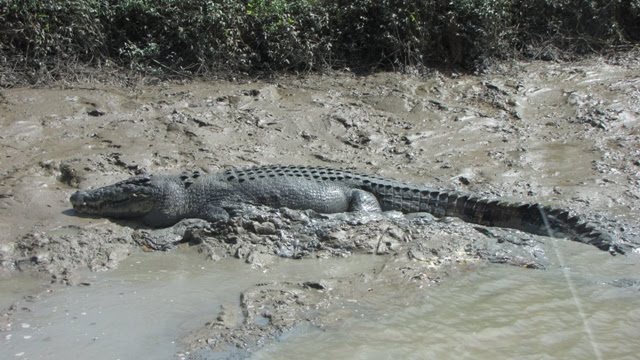
We spent our first day travelling through Kakadu visiting the Adelaide River Jumping Crocodiles. To travel in the safety and comfort of a vessel down the Adelaide River where some of the densest populations of the deadly saltwater crocodile reside was not only a nail-biting but exhilarating experience. To witness the sheer power of these ancient monsters was certainly eye-opening. Watching crocodiles launch themselves vertically two-thirds of their body length out of the water to grab a piece of meat from the end of a pole was a very timely reminder to be extremely cautious around every waterway or billabong in the Northern Territory.

We travelled from Adelaide River to the Bark Hut Inn for a delicious barramundi burger and then on to Cooinda where we enjoyed a very relaxing Yellow Waters sunset cruise. Gliding quietly along the waterways spotting birds, and even more crocodiles, we watched the sun set on a truly magnificent first day in the Territory.

While we were on the sunset cruise Sab had miraculously transformed a piece of Aussie bush into a very comfortable camp, complete with tablecloth, candles and red wine. There is nothing more enjoyable for me in life than to sit around a campfire beneath the magnificent Milky Way and Southern Cross, gazing into the flames and swapping stories.

Day two was spent travelling to several sites to marvel at ancient rock art. Once again Sab was able to provide an insight into the art that made the paintings come to life. The traditional landowners are very welcoming of visitors to their “country” to help foster a better understanding of their culture and deep relationship with the land. Our final stop for the day was at Bamurru Plains, a tented safari-style camp on the floodplains of the Mary River. To call this “wild bush luxury” is an understatement. As we sipped our drinks and snacked on delicious canapés we watched the sun set over the floodplains.

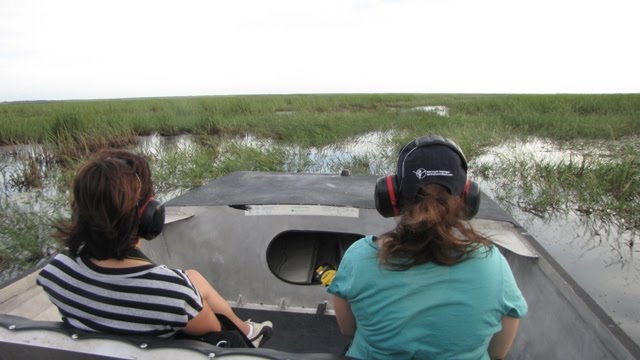
Day three saw us have an early start as we were about to experience the ride of a lifetime – an airboat ride over the floodplains to view the plethora of birdlife that reside here. The Mary River floodplains offer four distinct and very diverse habitats ranging from open reed/grasslands, melaleuca groves, carpets of waterlilies and lotus flowers to water pandanus environments teeming (and I mean teeming) with birdlife, buffaloes and, of course, crocodiles.

Morning tea was enjoyed in a fairytale melaleuca grove that was carpeted with a multitude of colourful waterlilies. A more picturesque setting could not be found. To sit quietly and take in the sounds of the birdcalls and the smell of the bush is a memory that will stay with me for a very long time.

As I sit and reflect on my adventure I take home with me a deep sense of pride that I am fortunate, not only to live in such a wonderful country, but to have been privileged to have experienced the very best on offer in the "Top End".

If you would also like to enjoy a similar adventure, please contact us and let us arrange your next holiday in Australia.